


U.S. Employment Agreement


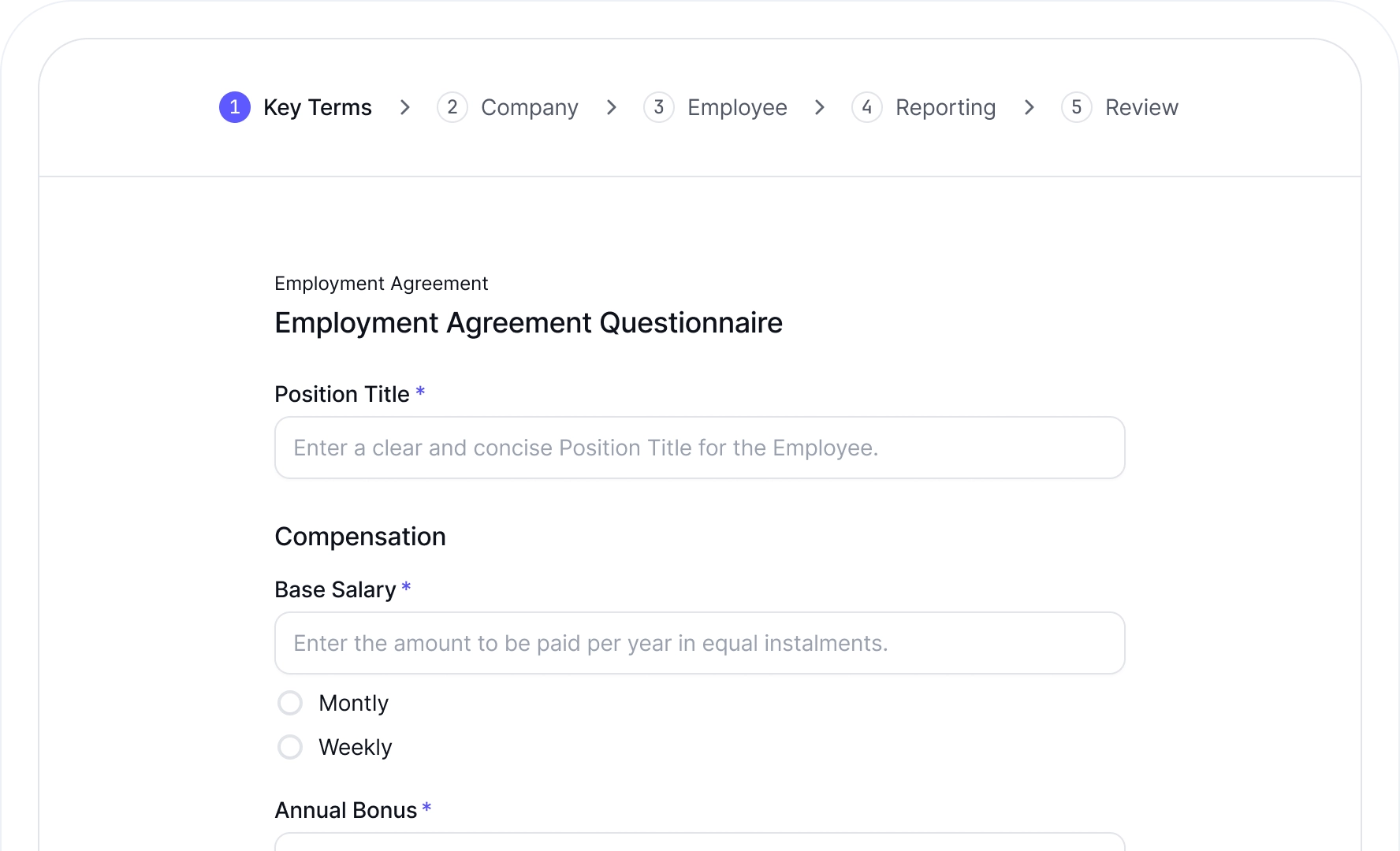
About Employment Agreement
An employment agreement (also known as a hiring contract or workplace agreement) defines the terms between employer and employee. It covers employment terms, compensation, confidentiality, and more.
Formalizing employment terms is a routine requirement for growing companies, yet most organizations still rely on ad-hoc documents or outdated templates. We’ve changed it.
It is designed with clear, plain language so you can focus on employee onboarding without having to decode legal jargon.
Skala’s employment agreement template is built to be:
Compliant with common legal standards and market practice
Fair to both parties
Flexible to suit different roles
What’s Inside
Just like Skala’s Independent Contractor Agreement, the Employment Agreement walks you through the critical clauses with built-in tips:
Things to Consider
Employment Term and At-Will
The Employment Agreement by Skala includes both a stated term (e.g., 12 months) and an at-will provision. This means employment can end at any time, with or without cause, or automatically at the end of the stated term unless renewed.
State Law Compliance
Employment laws vary by state. Check requirements on minimum wage, overtime, paid leave, and final paycheck timing in the employee’s work location.
Exempt or Non-Exempt Status
For the U.S.-based employments, correct classification under the Fair Labor Standards Act (FLSA) determines overtime pay obligations.
Equity Terms
If granting stock options or restricted stock, ensure compliance with tax, securities, and company employee stock option plan rules. Include a clear vesting schedule in the equity grant agreement.
Bonus Eligibility
Define performance metrics and payment dates to avoid misunderstandings.
Benefits
Confirm eligibility periods and coverage terms for health, retirement, and other benefits in your employee handbook or plan documents.
Confidentiality & IP Protection
This agreement includes confidentiality obligations but does not cover invention assignment or IP ownership. To make sure all IP (apart from what’s excluded under applicable labor laws, such as California Labor Code § 2870) is assigned to the company, you’ll need a separate IP assignment agreement. Many employers use a Proprietary Information and Inventions Assignment Agreement (PIIAA) for this as it covers prior inventions created for the company before official employment.
Outside Activities
Pre-approved external board or advisory roles must not conflict with company interests; maintain written approvals for records.
Non-Compete and Non-Solicit
Not included in this agreement. If you require them, verify enforceability under state law (e.g., California prohibits most employee non-competes).
Dispute Resolution
If selecting arbitration, confirm compliance with the Federal Arbitration Act and any state-specific rules; ensure the chosen arbitration body’s rules fit your needs. For example, in California the employer is required to cover the arbitration costs, including the arbitrator’s fees, regardless of the case’s outcome.

One document. Countless deals.
FAQ
Generally, yes. A written employment agreement is strongly recommended because it clearly documents the employee’s position, compensation, benefits, confidentiality obligations, termination terms, and governing law. This helps avoid misunderstandings and makes the agreed terms easier to prove and enforce.
At-will employment means either party can end the relationship at any time, for any lawful reason. Most U.S. states default to at-will. The employment agreement should state this explicitly. If the agreement instead specifies a fixed term or requires "cause" for termination, the employer's ability to let the employee go is significantly more limited and severance obligations may apply.
The employment agreement can summarize the employee’s equity eligibility or key commercial terms, such as the expected grant size and vesting schedule. The actual equity grant should be documented separately under the company’s equity plan and approved grant agreement. Those documents should cover the detailed terms, including vesting, exercise price, tax treatment, and any conditions on the grant.
The employment agreement should include strong confidentiality obligations. IP ownership and invention assignment are usually handled in a separate proprietary information and inventions assignment agreement (PIIAA). That agreement should assign to the company work product, inventions, and other IP created by the employee in connection with their role, subject to any exclusions required by applicable law.
A single template works well for most roles. Senior executives (C-suite, VP-level) typically negotiate additional terms: severance packages, change-of-control protections, double-trigger acceleration on equity, and broader benefits. Always customize the agreement for those hires. Also confirm that the template's governing law and at-will provisions are appropriate for the state where the employee is actually working — some states restrict or modify at-will employment by statute.
Launch Your Business with Confidence
Start for Free with Skala

Migrate it to Skala for maintenance

We will notify you of important deadlines

Impress your investors and get money fast

Import your actual and pending trademarks free of charge

Quickly generate NDAs, onboard contractors without hassle

We will help you with getting a bank account

Legal quizzes and guides

Access special offers and perks from our partners

If you need one, we'll get you introduced in no time
